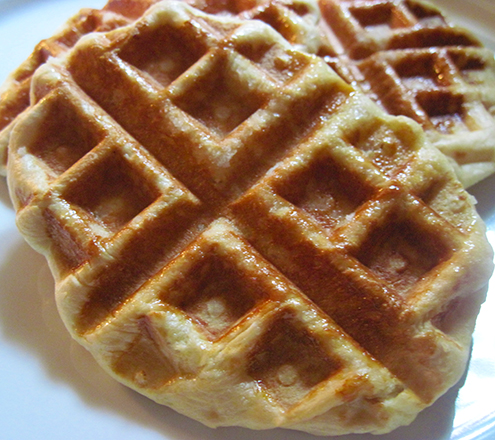
There are a million types of waffles…literally…they are eaten throughout the world particularly in Belgium, France, Netherlands, Scandinavia, Hong Kong, Vietnam and of course the USA. Some are light, airy and thin with yeast used in the batter, and others like the ones we make here in the USA are leavened with baking powder.
The word “waffle” first appears in the English language in 1725 and originated from the Dutch word wafel which can mean either honeycomb or cake. Waffles were first brought to North America in 1620 by the Pilgrims who learned about them in Holland.
Waffles remained widely popular in Europe for the first half of the 19th century but by the early 20th century, waffle recipes become rare in recipe books and there were only 29 professional waffle craftsmen left in Paris. Waffles were shifting from a predominately street-vendor-based product to an increasingly homemade product, aided by the 1918 introduction of GE’s first electric commercial waffle maker. By the mid-1930’s, dry pancake/waffle mix had been marketed by a number of companies, including Aunt Jemima, Bisquick, and a team of three brothers from San Jose, CA called the Dorsa brothers. It is the Dorsa’s who would go on to innovate commercial production of frozen waffles, which they began selling under the name Eggo in 1953.
Then in 1958, a Belgian restaurateur named Maurice Vermersch, showcased his version of the Brussels waffle at Expo 58 in Brussels. Following his success there, he made plans to introduce them to America, but was preceded to the U.S. by another salesman who sold his own yeast based Brussels Waffles (Gaufres de Bruxelles) with modest success at the 1962 Seattle World’s Fair. It was in 1964, however, when Maurice Vermersch finally debuted his Bel-Gem waffles at the New York World’s Fair that they finally took hold in the USA. The name Bel-Gem waffle, was originally intended as a marketing device to work around American’s poor recognition of Brussels geographically. The name stuck and quickly morphed into the distinctly American concept of the Belgian waffle.
Contrarily, the Liège Waffle is Belgium’s most popular variety created by an 18th century chef to the prince-bishop of Liège, but it was not until 1822 when Antonin Carême, the famous Parisian pastry Chef introduced a similar product in his writings called the Le Maitre d’Hotel Français. Although the product is mentioned in a few different places, a full recipe does not appear until 1921.
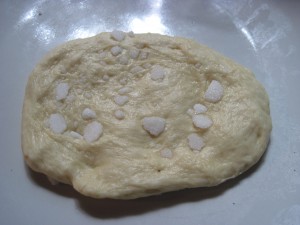
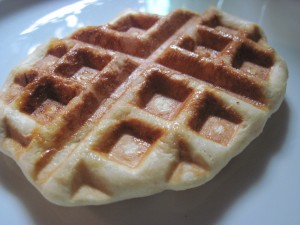
This type of waffle is very difficult to find in the USA and unless you make it yourself you may never experience the real thing. The dough is based on a rich, brioche dough that is combined with large grains of pearl sugar right before being placed on the waffle iron. These are purposely added right before the dough is cooked so that they caramelize the surface of the waffle as the waffle bakes on the iron. This distinctly crispy, yet chewy texture is uniquely European. Most recently, a native Belgian brought them to the USA and made them popular on the ski slopes of Vermont. The company called Waffle Haus (or Waffle Cabin in some locations), has now become popular in other ski resort areas. When I first heard about them, I ordered a box and yes I will say that they were addictive but so much better warm.
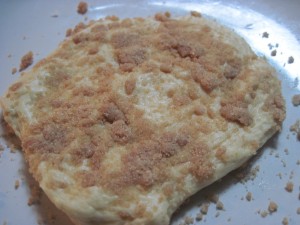
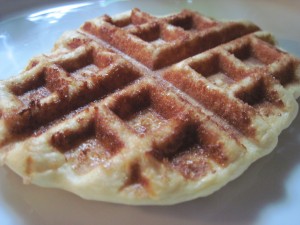
I decided I was going to use my versatile brioche dough recipe to try and see if it would work for this application…and it did. This delicious recipe can be used to make beignets, donuts and brioche and now is perfect to use for liege waffles. The only problem is sourcing the pearl sugar which can be only found online in a minimum of 5 pounds bags. To save myself some headaches, I tried using cinnamon streusel topping (which I make ahead of time and keep frozen in individual bags). I must say, I do believe that the ones with the streusel are my favorite above all. Coat the entire surface with the cinnamon streusel and lay it on the waffle iron. Watch the whole thing take minutes to cook up and caramelize for a quick and delicious treat. Serve them as is, with chocolate drizzle, whipped cream or even ice cream…don’t pass these up if you can help it.
So don’t feel like you have to go out and buy a huge bag of pearl sugar to try these unique treats, being just a little creative will get you a very similar taste and texture with a distinct but even more delicious cinnamon-y treat.
Liege Waffles With Cinnamon Streusel
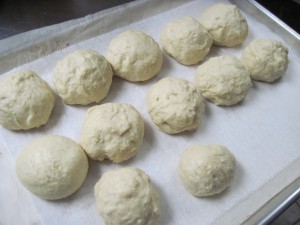
1 recipe Berliner donut dough (makes about 1 dozen 3 oz balls)
1 recipe streusel topping
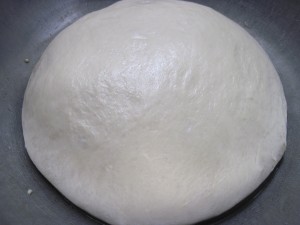
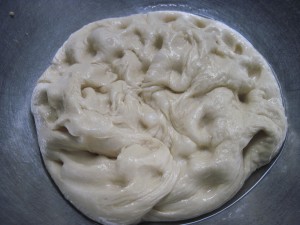
Follow the instructions to make the dough. I did make one change to the recipe so that it resembled the taste of the waffles I purchased. I added 4 tablespoons of vanilla in place of the water. So, I added ¼ cup of vanilla and then if I needed any more liquid I just added enough water to bring it all together.
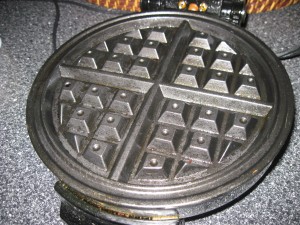
Once the dough is made and proofed, proportion it into 3 oz balls and cover them with plastic wrap while the waffle iron is heating up. Take each ball and flatten it out. If you are going to use the pearl sugar, then add it to the surface on both sides until it sticks then lay it upon the waffle iron and close the lid. It will take about 3-5 minutes to cook completely. If you are using the streusel, follow the same procedure. Simply delicious…
Leave a Reply