
In the early 1990’s, I worked for Citronelle restaurant at the luxury Latham Hotel in Baltimore. Of course, this was one of Michelle Richard’s restaurants, so all of the recipes we used were his…well, most of them were. His recipes were easy to work with for the most part, but I found that some of them needed a little tweaking. One of them was his puff pastry recipe which he also shared on Julia Child’s baking program. This recipe also appeared in the accompanying book of recipes compiled from the show.
My biggest problem with the recipe he shared was that there was just way too much butter and when you would bake the puff pastry, all of the butter melted out onto the sheet pan and created a mess. Recently, I modified his recipe by increasing the dough mass (detrempe, pronounced de-tromp) to accommodate the quantity of butter that he suggested. Chef Richard’s original recipe was:
2½ cups unbleached all purpose flour
1¼ cups cake flour
1 tablespoon salt
1 ¼ cups ice water
1 pound of butter, unsalted
The modifications that I made to the recipe appear below:
3 cups unbleached all purpose flour (makes 3 sheets of dough)
1½ cups cake flour
1 tablespoon salt
1 ¼ -1 ½ cups ice water (depends on the weather)
1 pound of butter, unsalted
Add both types of flour, salt and 1 cup of water to the bowl of your stand mixer. Using the paddle, begin mixing the dough until it comes together in a ball. If it needs more water, continue to add as much as it needs until it forms a soft, pliable but NOT sticky dough.


Remove from the bowl and knead it a little then wrap this in plastic and allow it to rest for 30 minutes.

Once the dough is resting, remove your butter from the fridge. Wrap the butter in between some plastic wrap or some parchment paper and pound it out until it forms one big knob of butter. I add a little flour to it to prevent it from sticking. The butter should still be firm but NOT rock hard so that it can incorporate easily into the dough. Once it has come together, set it aside for a few minutes.

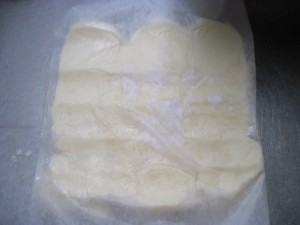

By now the dough has rested, and the next step is to remove it from the fridge and place it on a lightly floured surface. Using your rolling pin, roll out four flaps but leave a small center mound, like this…

The center mound is important, because that is where you will place your butter.

Add the butter to the center mound, and fold in each flap and make sure to form a complete seal. At this point, the butter and the dough together will resemble a sealed envelope.
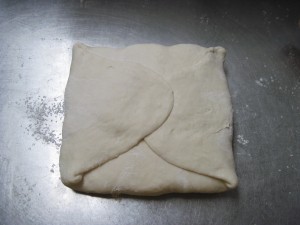
Use your rolling pin to gently pound out the dough into a rectangle shape, don’t press too hard or the butter will ooze out.

Once you have done this, make your first single turn, which folds one side of dough over the other like a sheet of paper. The key (open edge) should always be on the left hand side.


Mark the dough with one finger to remind yourself how many turns you have completed.

In total, you will make six turns. You can do this by making them all single turns, but if you are lazy like me, you will incorporate some double turns too. The double turns involve a fold of each side in towards the center, and then one side is folded on top of the other like this…


The six turns will yield 944 layers of dough. So each time you roll out the dough to make the next turn, the key which was on the left side should now be turned towards you before you begin rolling again. You will make a total of 2 single turns and 2 double turns. I usually alternate the single and double turns and mark the dough each time.

Remember not to roll the dough too thinly or it will break the layers in the dough and the dough will not rise correctly once it has baked . After completing each turn, refrigerate the dough for 30 minutes. This will allow the dough to firm up again and also deactivate the gluten so that you can roll it out easily. You can complete 4 turns and then refrigerate the dough until ready to use and then make your final turn. I usually do all of my turns ahead of time so that I don’t forget.
This is really easy to make and only takes a little practice to master…don’t be afraid, give it a try.
Leave a Reply