 Both of my parents were born and raised in Cairo, Egypt, and although they were of Greek heritage, the Middle East was a very cosmopolitan place in those days filled with people from many different cultures. After leaving Egypt, they moved to Brazil where I was born and then several years after that they moved again to Australia. All of these countries were filled with immigrants from many nations who were all looking for the same thing…a better life for themselves and their families. We had neighbors from Syria, Japan, Italy, Ethiopia, Sudan, Lebanon, Hungary, Czechoslovakia, the UK and a slew of other nations, and it still amazes me to this very day that we all got along and never exchanged a cross word with any of them. We were all in the same boat and one always helped the other…
I guess you could say that I fell in love with food from other cultures before I could even walk or talk. It was not unheard of for each of our foreign neighbors to share their traditional foods with us on a regular basis. Each and every day without fail there was a knock at the door with neighbors bringing samples of things they had prepared to share with us and vice versa. I was always taught to make extra food because you just never knew who was going to stop by for a visit, or who would need your help with a spare meal on any given day. This is a tradition I still carry with me today…
One of the desserts that crossed the boundaries of several different cultures is one that I grew up calling by its Egyptian name, basbousa (pronounced baz-boo-sa). My mother would make it for us regularly, and we would all dive into the pan as it made its way out of the oven and was generously soaked with a light, fragrant syrup that was traditionally flavored with either orange or rosewater. As kids, we would attack the well cooked edges first and then worked our way in.
In Lebanon this is known as namoura, in Syria it goes by the name harissa and in Greece and Turkey it is called revani or ravani.
Basbousa is made with butter and baked, yet there is another version called halva tou koutaliou (spoon halva) that is cooked on the stovetop with oil instead of butter and poured into molds while still liquidy and allowed to set. Once the dessert has set it is then inverted out of the molds during service and plated. This stovetop version is also found in the Indian culture and is known as sooji halwa. I want to clarify that this is not the same halva that is made from tahini (ground sesame seeds)…although the name is the same, the product is very different.
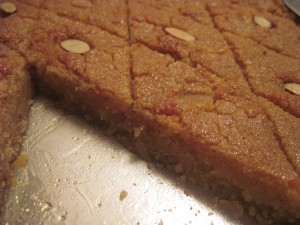
Aside from being baked, basbousa uses coarse semolina whereas the stovetop version uses the finely milled version. This is something that most recipes will not tell you. I have also come across recipes that use flour, eggs and yeast of all things, but I’m here to tell you that they are not necessary. The only leavening you will use will be some baking soda, which will help in developing the golden color for the top and not used for leavening purposes at all. Some recipes also use yogurt or kefir, which is a liquid yogurt drink and both are acceptable instead of using the milk as I have. The most important thing to remember if you are using yogurt or kefir instead of milk is that you will also have to add a little water so that the semolina can absorb enough moisture to achieve that lovely nutty texture that basbousa is known for. Sometimes my mother would add a few tablespoons of dessicated coconut to change things up a little, but it is equally delicious without.
Basbousa is served regularly throughout the Middle East and is also one of several desserts that are served during Ramadan, which is celebrated through the month of August. Serve this traditionally with the syrup or try it with a light bittersweet chocolate glaze for a more glorious experience…this is a simple but always delicious and very addictive dessert.
Soaking Syrup
1 cup honey
2 cups water
1 cup sugar
1 tablespoon lemon juice
1 or 2 cinnamon sticks
1 or 2 cardamom pods **optional
2-4 whole cloves **optional
Orange water **optional
Rose water ** optional
Add all of the ingredients to a small pot, stir them well until just combined and bring them to a boil and then reduce the heat to a simmer.


Cook on low heat for about 10 minutes. When using honey, you may have to remove some impurities that will collect on the surface. It may take a few times to remove them all, but the taste of the syrup with the honey has much more depth.

We used to make the spiced version at home using the cardamom, cloves and cinnamon. If you prefer to use the orange water or rose water, make sure to add this once the syrup has finished cooking. Add enough of these flavorings to your taste. If it is concentrated you will have to use less…but always add to your taste. Once the syrup has cooked, set aside until the basbousa has baked.
Basbousa
3 cups coarse semolina
2 ½ sticks salted butter (10 oz)
1 ½ cups sugar
2 ¼ cups whole fat yogurt, kefir or buttermilk (if using yogurt, add 1/2 cup water)
2 teaspoons vanilla (if using orange or rose water only add 1 teaspoon)
2 teaspoons baking soda
Almonds for garnish (sliced, slivered or whole)
¼ cup dessicated coconut **optional (if this is used, remove ¼ cup of semolina)
In a medium sized stock pot add the butter and melt over medium heat.

Once the butter has melted, add the semolina and stir continually so it will not burn. The semolina will begin to take on a golden brown color, so when you see this, continue to stir well incorporating it all together, about 10 or 15 minutes. You will begin to smell a lovely nutty aroma, which is very important. If you do not toast the semolina, the semolina will remain raw and this rawness will be very pronounced in the final result.

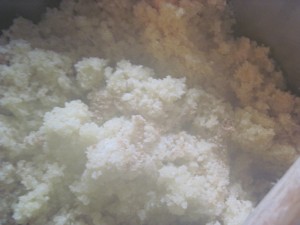
Once the toasting part is done, remove the mixture from the heat and add the sugar all at once, and stir well.

Put this pan back on the heat and add the yogurt and vanilla and cook gently until it begins to thicken.
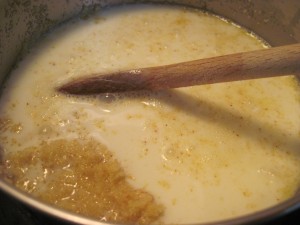
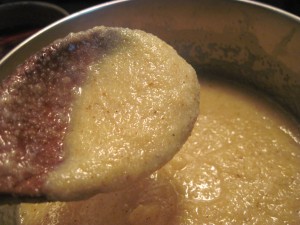
If you are going to add coconut, add it at this time. Once thickened, add the baking soda and pour this into a ¼ size sheet pan that has been sprayed with a pan release.


Allow this to sit in the sheet pan at room temperature to absorb all of the liquid for 1 hour prior to baking. After the required time, the unbaked basbousa will have firmed up and now needs to be sliced before baking. Use either an oiled bench scraper or a sharp knife to cut into diamonds or squares and then bake on the lower level of a 350°F oven for 30 minutes. After 30 minutes, move this to the top rack of the oven for another 30 minutes or until the top has become a lovely golden brown color.

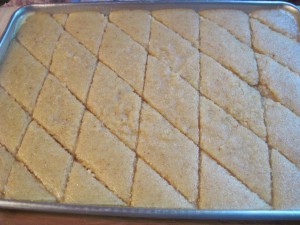
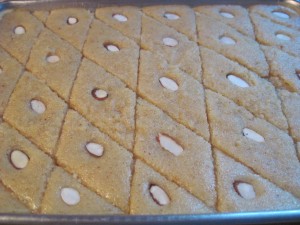
Once the dessert is removed from the oven, use a sharp knife to re-slice through the each piece and then gently spoon over the prepared syrup. Initially, add about half of the syrup and ‘flood’ the pan, it will be quickly absorbed into the still warm dessert.


Once the syrup is absorbed, add a little more. In total you will use approximately ¾ of the quantity of prepared syrup. Reserve the rest to garnish each plate during service. Allow the basbousa to cool completely and serve at room temperature or chilled.


Leave a Reply